

Differences Between RWD, FWD, AWD, and 4WD
Author: Toby Date Posted:17 October 2025


When you’re shopping for a car or upgrading your current ride, drivetrain jargon can get confusing. RWD, FWD, AWD, 4WD — they all sound technical, but they make a huge difference in how your car feels on the road (and off it). Here’s the lowdown from a driver’s point of view.
Know Your Drive System
Rear-Wheel Drive (RWD)
RWD sends power to the back wheels, pushing the car forward. You’ll find it in utes like the Toyota Hilux and Ford Ranger (older models), Aussie classics like the Holden Commodore and Ford Falcon, and performance icons such as the BMW 3 Series or Mercedes C-Class.
On the road, it feels balanced — the steering handles direction while the rear wheels deal with the power. That means smoother cornering when you’re pushing it a bit harder. The flip side? Put your foot down too hard in the wet and the rear can step out. That’s because the back tyres are handling all the engine’s power, they’re more likely to spin when the road’s slippery. Once they lose grip, the rear of the car wants to swing wide while the front keeps pointing forward — that’s oversteer. It can feel like the back of the car is trying to overtake the front. Drivers with experience can catch and correct it, but for anyone not ready, it happens quick and can be pretty unnerving.
Fun if you’re in control, a bit hairy if you’re not. It’s also why RWD utes make towing feel stable, with the load sitting squarely over the rear axle.
Front-Wheel Drive (FWD)
Most everyday cars run FWD. Popular cars like Toyota Corolla, Hyundai i30, Mazda 3, Honda Civic, or Volkswagen Golf. Here, the front wheels do it all — they pull the car forward and steer at the same time.
You’ll notice FWD feels planted in the rain because the engine’s weight sits over the driven wheels. It makes cars lighter, more fuel efficient, and easy to live with day-to-day.
The downside is when you push through a tight bend, it can understeer. Because the front wheels are already busy steering and putting power down, they can run out of grip first. Instead of following the curve smoothly, the car tends to push wide — like it’s trying to keep going straight even though you’re turning the wheel. It’s less dramatic than oversteer in a RWD, but it can feel frustrating if you’re trying to corner quickly.
All-Wheel Drive (AWD)
AWD is the middle ground — it can send power to all four wheels, adjusting automatically as conditions change. It’s common in family SUVs like the Toyota RAV4, Subaru Forester, Mazda CX-5, and Nissan X-Trail, as well as performance cars like the Audi Quattro range or Subaru WRX.
Behind the wheel, AWD gives you confidence. Wet roundabout? It grips. Gravel driveway? It grips. Even on the highway, you’ll notice it feels steady and planted at speed. The trade-off is weight and fuel use — and when it’s time for a service, there’s more going on under the skin than with FWD or RWD.
Four-Wheel Drive (4WD)
This is the real deal for off-roaders. A proper 4WD has a transfer case and low-range gearing, letting you lock drive to all four wheels. You’ll find it in Land Cruiser, Nissan Patrol, Jeep Wrangler, Ford Ranger, and Mitsubishi Pajero or Triton — all built to handle the rough stuff.
Driving a 4WD feels different — in low-range, you’ve got heaps of torque at crawling speed, and the suspension usually soaks up punishment better. But they’re heavy rigs, thirstier on fuel, and not exactly at home in tight city carparks. Still, when you’re deep in the bush and need traction, nothing else compares.
Pros and Cons of Each Drivetrain
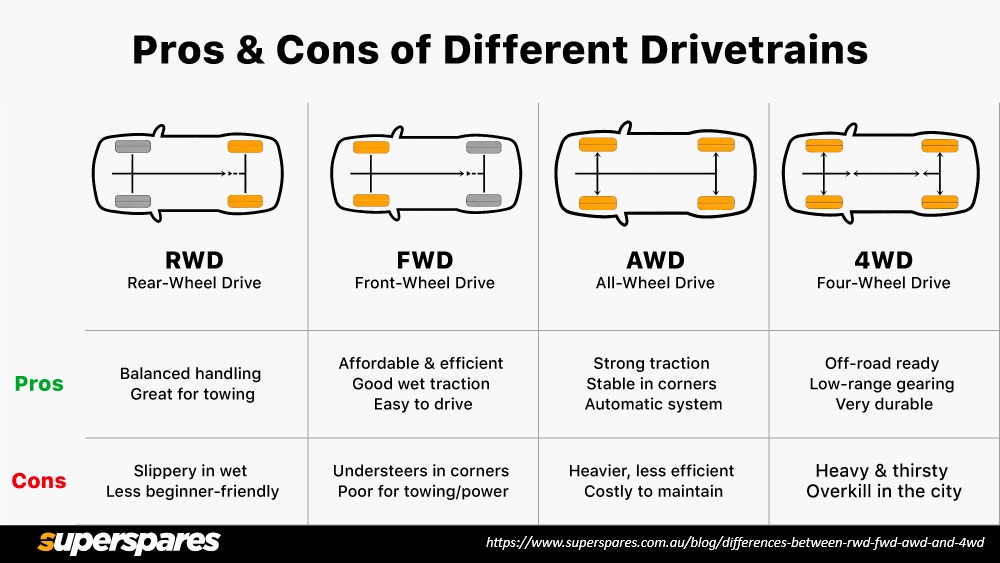
RWD (Rear-Wheel Drive)
✅ Balanced handling, smooth cornering feel
✅ Stable under load, great for towing
❌ Slippery in the wet if pushed too hard
❌ Not as confidence-inspiring for new drivers
FWD (Front-Wheel Drive)
✅ Light, efficient, and affordable
✅ Better traction in everyday wet conditions
✅ Easy and predictable to drive
❌ Understeers when cornering hard
❌ Not built for towing or big power
AWD (All-Wheel Drive)
✅ Superb traction in rain, gravel, or mixed terrain
✅ Feels stable at speed and around corners
✅ No driver input — it just works
❌ Adds weight, hurts fuel economy
❌ More expensive to maintain
4WD (Four-Wheel Drive)
✅ Built for off-road adventures — mud, sand, rocks
✅ Low-range gearing makes tough terrain manageable
✅ Strong and durable setups
❌ Heavy and fuel-hungry
❌ Overkill if you never leave the city
The Right Parts for Every RWD, FWD, AWD and 4WD
Each drivetrain has its sweet spot:
- RWD for balanced handling and towing (think Commodore, Falcon, Hilux).
- FWD for efficient commuting (Corolla, Mazda 3, Golf).
- AWD for grip and stability in mixed conditions (RAV4, Forester, WRX).
- 4WD for hardcore off-road adventures (Land Cruiser, Patrol, Pajero).
No matter which system you’ve got under you, keeping it maintained is what makes the difference. That means looking after your CV joints, drive shafts, and differentials, as well as wear items like shock absorbers that keep tyres planted and handling predictable.
At Superspares, we stock parts for all drivetrains, from hatchbacks to hardcore rigs. When it’s time for an upgrade, you’ll find everything you need at our automotive parts store — whether you’re chasing better cornering, more traction, or outback-ready reliability.

Written by Toby Martin
Automotive Content Specialist

